AI Comes Fifth When Building Your AI Sales System Architecture
I recently shared a story in Sydney Australia where I delivered an keynote on AI for Sales I shared a recent AI sales failure I had not a a success. I think it is important to do this because too many speakers and AI experts focus on AI’s potential and ROI but not enough share their failures and realities of leveraging AI for sales and revenue operations.
Here’s my AI sales failure story:
A while back, I signed up for an AI-powered outbound sales platform. I uploaded an ideal client profile, gave the system some basic instructions, and let it build a list of 10,000 prospects. The platform was supposed to write like me, contact the right people, and start conversations while I slept. I set this up while watching Netlfix before bed… I clicked launch and then went to sleep.
By morning I had complaints, unsubscribes, angry replies, and a mess to clean up. The technology found people, generated messages, and sent them at a scale no human team could match. I had given it volume without enough judgment. Loaded with hallucinations and often reaching out to the wrong people the AI missed the mark, BADLY. My sales philosophy, writing standards, process, and experience were mostly absent from the system, so I had opened the fire hose before checking what was flowing through it.
That experiment was a failure but there were lessons! I am seeing the same mistake is happening inside sales organizations every day. A company buys ChatGPT Enterprise, Microsoft Copilot, a conversation intelligence platform, an AI prospecting tool, or some new agentic sales system. The announcement goes out, the team attends a webinar, a few people run with it, a few use it badly, and many ignore it completely.
Six months later, the company has another layer of software and little evidence that its salespeople are having better conversations, qualifying opportunities more accurately, or building stronger client relationships. Or worse, their people are shipping AI slop and wasting time on training their AI instead of making calls. The company started at the fourth layer and skipped the first three.
Over 25 years I have worked with sales organizations in Canada, USA, Australia, Africa, Southeast Asia, Dubai and South America and while there are local nuances, most sales best practices are universally effective. The same problematic sales issues also pop-up everywhere. I have seen strong tools fail inside weak systems and fairly simple tools produce excellent results inside disciplined ones. AI follows the same pattern. It becomes useful when it enters an environment that already knows what good selling looks like, and there’s a process for this.
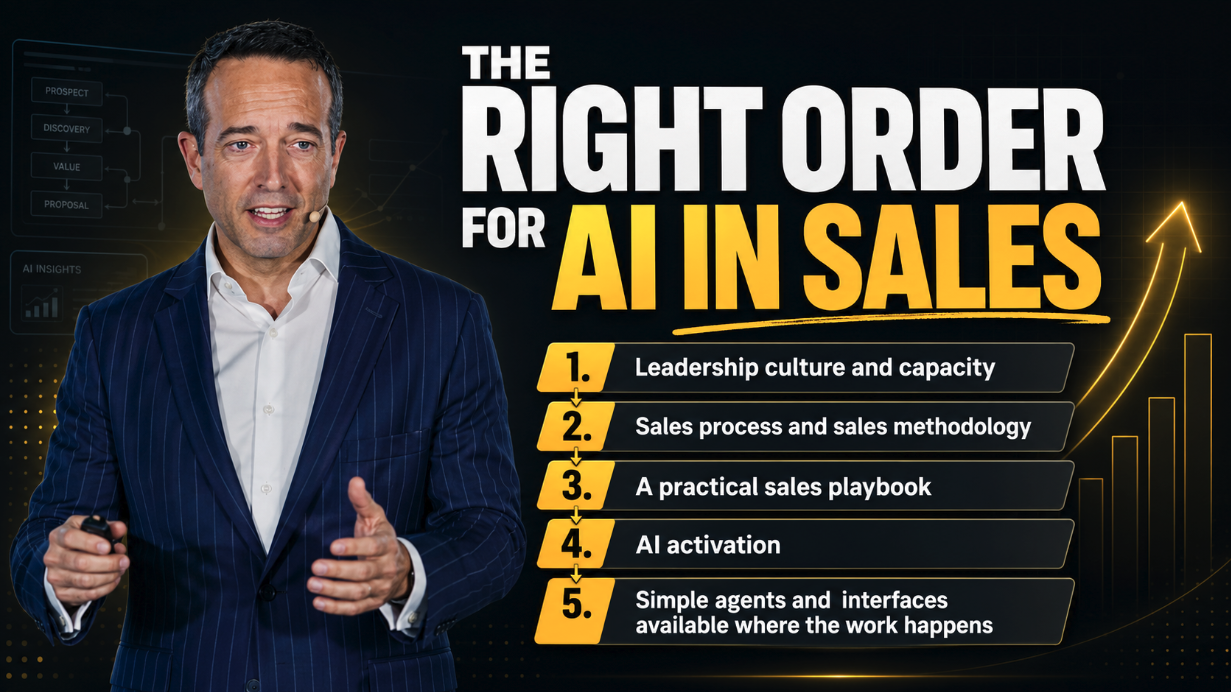
The AI sales implementation model I use has 5 layers:
- Leadership culture and capacity, including coaching systems and best practices
- Sales process and sales methodology
- A living sales playbook
- AI activation
- Agents and interfaces that make the capability easy to use where salespeople already work
Each layer supports the next one. When the early layers are weak, the technology has very little worth amplifying.
1. Leadership culture and capacity
Salespeople pay close attention to what their leaders do under pressure. They notice whether a manager asks useful coaching questions or jumps straight to the forecast. They notice whether experimentation is encouraged or every mistake becomes evidence that the new tool is unsafe. They also notice when the person setting the AI strategy has barely used the technology.
A sales manager does not need to become a developer. They do need enough technology intelligence to understand what the tools can do, where they tend to fail, and what responsible use looks like in a live sales situation. A manager operating at a 4 out of 10 in practical AI use will have difficulty leading salespeople who are already at an 8 or 9.
The first leadership question should be practical: where will the recovered capacity go? Most AI business cases talk about time saved. Saving 10 hours a week sounds impressive until nobody decides what happens to those 10 hours. They often get absorbed by internal meetings, extra reporting, more email, or an expanded list of low-value tasks.
A better leadership plan names the activities that deserve more human attention. For a sales team, that may include account planning, discovery meetings, building relationships across a buying committee, value-added follow-up, coaching, and preparation for complex negotiations. The recovered time only matters when leaders protect it and set expectations around how it will be used.
Coaching systems are central to this. Many sales managers coach from memory. They listen to part of a call, make a few observations, and move to the next urgent issue. The quality varies by manager, by rep, and by how busy the quarter happens to be. Conversation intelligence can review more calls, identify patterns, and give managers better evidence, provided the organization has an agreed coaching standard:
- What does a strong discovery call look like in your organization?
- How do you know the salesperson has uncovered business impact rather than surface-level interest?
- What evidence should exist before a deal moves to the next stage? How should the rep respond when a buyer wants pricing too early?
Those standards come from leadership and experience. Once they are clear, managers can apply them more consistently with AI support.
Culture also determines whether the system will receive honest data. If salespeople believe call recordings exist mainly to catch mistakes, they will resist. When managers use the information to help people improve, share best practices, and work through difficult deals, adoption becomes much easier.
Technology usually exposes a low-trust management culture rather than repairing it.
A capable leadership team sets the intent, builds practical skill, protects time for higher-value work, and creates a coaching rhythm that people experience as useful. This gives AI a productive environment to enter.
2. Sales process and sales methodology
- A sales process shows the stages an opportunity moves through.
- Sales methodology gives salespeople a common way to think and act within those stages.
- Many companies have the first one. Far fewer have both.
The CRM may contain stages called prospecting, discovery, proposal, negotiation, and close. Those labels help with reporting, but they do not tell a salesperson how to conduct discovery, when a proposal is justified, or what a credible commitment looks like before an opportunity advances.
That gap creates wide variation across the team. One salesperson sends a proposal after a promising first call. Another waits until the decision process, impact, buying criteria, and future state are clear. A third moves nearly every positive conversation into the forecast. The pipeline looks organized from a distance, although the work underneath it is inconsistent.
AI trained on this environment learns from the inconsistency. It may summarize a weak call accurately, draft a proposal too early, or recommend a next step based on unreliable CRM stages. The output can look polished while still moving the deal in the wrong direction.
Watch an excerpt from Shane Gibson’s AI Sales Keynote in Sydney Australia on Sales Process in AI:
If you ask me what my sales ethos or definition of what selling really is I will tell you that “Sales is about creating an environment where an act of faith or leap of faith can take place.” The buyer is making a decision under uncertainty. They are trusting the salesperson, the company, the proposed solution, and the promises being made about a future result. That trust develops through credibility, intelligent questions, relevant insight, and a pattern of kept commitments.
Your methodology needs to protect that trust buidling process and give AI a clear standard to work from. An account research assistant, for example, should evaluate companies against a defined ideal client profile. Finding more names is easy. Identifying the organizations that offer the highest return on the salesperson’s time, energy, ability, money, and reputation requires sharper criteria.
An AI discovery assistant or agent should understand how your team moves from broad context into problems, impact, opportunity, future state, and commitment. Twenty generic questions pulled from the internet will rarely create a good client conversation. The questions need to fit the buyer, the stage of the relationship, and the business decision in front of them.
A call coach should know that confidence and airtime are poor substitutes for curiosity. The salesperson may sound polished and still miss the issue that will eventually stall the deal. The coaching system needs to recognize whether the client did enough of the talking, whether the rep explored the consequences of the problem, and whether a specific next step was earned.
A proposal assistant or AI agent should also be able to flag incomplete discovery. Producing a document quickly has little value when it rests on assumptions or a weak understanding of the buying committee. The same principle applies to relationship development.
Buyers move through their buying process on their own pace but trust is an accelerant. Salespeople create trouble when they force commitment while the buyer is still exploring. AI can identify missing contacts, gaps in the decision process, and changes in engagement, but the underlying relationship model has to come from the organization’s methodology.
I have worked with salespeople in Vancouver, Mumbai, Johannesburg, Dubai, Toronto, and many other markets. The channels change and business customs vary, yet the fundamentals remain remarkably consistent. Buyers want to feel understood, they pay attention to credibility, and they need confidence that the person across the table can deliver. Those are useful standards for AI because they have been tested in real sales environments.
3. Bake it into a living sales playbook
The playbook is where leadership intent, process, methodology, and field experience become usable by the whole team. I have seen plenty of sales playbooks launched with great enthusiasm and then abandoned in a shared drive. They were written like policy manuals, filled with corporate language, and separated from the daily work of selling. A rep preparing for a meeting at 7:30 in the morning is unlikely to search through 140 pages to find 3 useful questions.
A living playbook works more like a franchise manual. It helps a salesperson make a better decision at a specific point in the sales process. It should answer questions such as:
- Which accounts deserve the most attention?
- What does an A-level opportunity look like?
- What needs to happen before the first meeting?
- What information must be understood before a proposal is created?
- Who influences the decision, formally and informally?
- Which proof points fit this type of buyer?
- How should the team add value between meetings?
- When should a manager, executive, or technical expert enter the deal?
The playbook also needs examples from real work. Frameworks explain the standard; examples help people recognize it. Strong call excerpts, discovery notes, account plans, proposal sections, and post-mortems can show how the methodology appears in an actual client conversation.
This is where company-specific AI starts becoming valuable. Large language models already know a great deal about generic sales advice. Your advantage sits in the knowledge that is specific to your business and market.
Your best salesperson may know how to qualify an opportunity without making the buyer feel interrogated. A technical specialist may ask one question that regularly uncovers an expensive hidden risk. A founder may have a story that helps buyers understand the cost of waiting. Your team may know that one signal usually means procurement has entered the process or that a common objection is covering a different concern.
That knowledge is difficult to scale when it remains inside a few experienced people. Once it is captured, reviewed, and organized in the playbook, that knowledge becomes available across the team through AI.
The playbook should include the boundaries as well. Teams need clear direction on confidential information, customer data, accuracy, brand voice, approvals, and the client interactions that require direct human involvement. A prospecting assistant may prepare research and suggest an approach. A proposal assistant may assemble a first draft. Client-facing material still needs the right review before it leaves the company.
Personalization deserves special attention. Adding a name, company, recent announcement, and job title to a message does not prove the salesperson has thought seriously about the recipient. Buyers can feel the difference between data inserted into a template and a message written with genuine relevance. A strong playbook helps preserve that relevance as the organization increases its use of technology.
4. Activate the playbook with AI
With the first 3 layers in place, the organization can make sensible decisions about AI. Start with sales activities that are repeated often, consume meaningful time, and have a clear standard for good work. Account research, meeting preparation, call analysis, CRM updates, follow-up, proposal drafting, and account planning are common starting points. The exact choice should reflect the team’s biggest source of friction rather than the latest product demonstration.
The next decision concerns the role AI should play. Some work can be automated because the rules are clear and the relationship risk is low. Other work benefits from augmentation, where the system prepares information, drafts options, notices gaps, or checks quality while the salesperson remains responsible for judgment and execution.
An account research assistant can compare a company to the ideal client profile, review trigger events, and prepare an initial opportunity brief. The salesperson still decides which issue matters, who should be approached, and why a conversation would be worthwhile.
Meeting transcripts can be turned into notes, CRM updates, and a follow-up draft. The salesperson verifies commitments and adds what was understood from tone, hesitation, politics, or history.
A call-coaching assistant can score discovery against the company’s methodology and point out missed questions, allowing the manager to focus on the rep’s thinking and behaviour. A proposal assistant can pull from the discovery transcript, approved templates, case studies, and pricing rules, while the account team remains responsible for accuracy and every promise being made.
I often use the Ironman analogy because it gives people a practical picture of augmentation. Tony Stark remains the person making the decisions. The suit gives him more information, speed, reach, and capability. In sales, the human brings context, curiosity, ethics, empathy, and accountability. AI can extend those strengths and handle parts of the work that drain time without improving the relationship.
AI for Sales Rule #1: “Start with a human spark and finish with a human fingerprint.”
I use that line because it describes an operating discipline. The initial thinking, point of view, and intent should come from someone who understands the customer and the business. AI can help develop the work, challenge assumptions, and speed up production. A person who is accountable for the outcome reviews what goes out.
The build sequence matters. Run the task manually until the team understands what good work looks like. Develop a prompt and test it on real examples. Improve it until the output is consistently useful. Turn that process into a specialist assistant, then connect it to other systems after the team trusts the results.
Building the agent first usually creates a larger troubleshooting problem. A focused discovery coach or proposal assistant is easier to test, improve, and govern than a broad system that promises to manage the whole sales cycle.
5. Put simple agents and interfaces where the work happens
A good AI system can still fail because it asks too much of the salesperson. Salespeople move between email, CRM, video meetings, messaging apps, LinkedIn, proposal tools, and their phones. They prepare for calls while travelling, update opportunities between meetings, and sometimes remember an important detail while walking through an airport.
A system that requires them to open another platform, find a long prompt, upload several files, and explain the account from the beginning will lose adoption quickly. They may use it for a week after training, then return to old habits. The playbook and AI capability need to appear inside the sales workflow.
An AI for Sales Client Case Study (Keynote Excerpt):
A salesperson looking at an opportunity in the CRM should be able to ask what is missing before discovery or what evidence is required before moving to proposal. The assistant should already understand the account, current stage, past interactions, company methodology, and relevant playbook standards.
After a call, the transcript can move through the agreed documentation and coaching process. Before a proposal is created, the system can check whether the required discovery information exists. When an account shows a meaningful trigger event, the rep can receive a recommendation with enough context to judge whether outreach makes sense.
The interface might be a CRM panel, a message inside Teams, a short form, or a voice note on a phone. The best choice fits the team’s existing business rhythm.
Prompt writing should sit behind the interface wherever possible. The agent can carry the system instructions, playbook, methodology, examples, permissions, and quality checks. The salesperson should only need to provide the context that cannot be preloaded, such as what changed in the account, what the buyer may be reluctant to say, or what the relationship can support.
Specialist agents tend to work well because their purpose is clear. People understand when to use an account researcher, discovery coach, call reviewer, proposal assistant, or follow-up assistant. They also know what kind of output to expect and who remains responsible for the final decision.
Ease of use should preserve the thinking that develops sales judgment. A new salesperson who blindly accepts every suggested question is learning very little. A capable salesperson who uses the same assistant to prepare faster, challenge assumptions, and identify blind spots is becoming more effective. The interface should reduce wasted effort while leaving the valuable thinking in the hands of the salesperson.
The 5 layers need to operate as one system
Leadership sets the purpose, expectations, and coaching rhythm. Sales process and methodology define the work. The playbook captures best practices and company knowledge. AI applies that knowledge to specific activities, and the agents make it available at the moment a salesperson needs help.
Treating these as separate projects creates predictable problems. IT selects a platform without enough sales context. Sales enablement builds content that is rarely used. Managers receive dashboards without a coaching method. Salespeople are told to adopt tools that create more work before they create any benefit.
The work needs shared ownership. Leadership remains accountable for the business outcomes. Sales enablement maintains the playbook. Managers coach the behaviours. Salespeople test the system against real accounts and provide field feedback. IT, legal, data, and security teams establish safe boundaries without turning every pilot into a 9-month committee exercise.
Customers should experience the result through better preparation, more relevant questions, faster follow-through, and a salesperson who remembers what matters to them. The measurements should reflect that experience and the sales results behind it.
Useful indicators may include discovery quality, meeting preparation time, proposal turnaround, CRM accuracy, weak opportunities removed earlier, coaching frequency, win rate, deal quality, retention, and account expansion.
Also measure where the time goes. Capacity saved by AI does not automatically become productive selling time. Leaders need to see whether salespeople are investing it in the right accounts and the conversations that move those relationships forward.
Start with one real sales problem
Large AI programs can spend months getting ready to get ready. A smaller pilot gives the team evidence, creates internal skill, and exposes gaps in the process before those gaps are multiplied across the company.
Pick one activity that happens frequently and causes enough pain to matter. Discovery preparation is often a good place to begin. Call coaching, follow-up, CRM capture, and proposal drafting can also produce useful early results.
Map how the activity is performed today. Identify the people who do it well and document what they do differently. Connect the activity to the sales methodology. Add the steps, examples, and boundaries to the playbook. Test a manual AI prompt on real work and improve it through several rounds. Once the output is reliable, build the assistant and place it in the workflow.
Managers then coach people on how to use the output and apply judgment. The team measures quality, adoption, time saved, time reinvested, and the sales result. That information determines what gets improved or expanded next.
The companies that do well with AI will know how they sell, what they believe about customers, and what excellent work looks like at each step. They will make that knowledge accessible without asking every salesperson to become a prompt engineer.
Build the leadership capacity, methodology, and playbook first. Then AI has something worth amplifying.
About Shane Gibson – Keynote Speaker on AI for Sales
Shane Gibson is a world-class keynote speaker on AI for Sales, B2B Sales and sales leadership. He’s also a sales strategist, author, and trainer who helps organizations accelerate growth by combining proven sales methodology with practical AI adoption. He has delivered keynotes, conference presentations, and sales kick-offs across Canada, the United States, Australia, Chile, Colombia, Brazil, South Africa, Zimbabwe, India, Malaysia, and the United Arab Emirates.
Shane has been speaking on AI for Sales since 2018 and is known for his high-energy delivery, sharp business insight, and practical takeaways, Shane gives sales leaders and teams strategies they can apply immediately to improve prospecting, deepen client relationships, strengthen sales process, and use AI more effectively.
Whether opening a global conference or challenging a sales team at its annual kick-off, Shane delivers relevant, engaging, commercially focused presentations that inspire action, build confidence, and create measurable momentum long after the event.
Some of Shane’s personal keynote speaking and training clients include: Canada Mortgage and Housing Corporation (CMHC), Ford Motor Company, Reliance Industries, Corning, BMO Financial Group, Sun Life, Wellington-Altus, CPA Canada, HUB International, Elavon, Bluestar, The US Department of Commerce, Sherweb, Maximizer, American Marketing Association, and the World Trade Centre Vancouver.
FAQ: AI for Sales Implementation Model
What are the five layers of an effective AI for Sales implementation model?
The five layers are leadership culture and capacity, sales process and sales methodology, a living sales playbook, AI activation, and agents and interfaces that make the capability easy to use where salespeople already work. Each layer supports the next, so weak foundations leave AI with little value worth amplifying.
Why must leadership culture and capacity come before AI activation?
Leadership establishes the purpose, expectations, coaching standards, and responsible-use practices for AI for Sales. Leaders also need enough practical technology knowledge to understand what AI can do, where it can fail, and how it should be used in real sales situations. Without capable leadership and a supportive culture, teams may misuse the technology, ignore it, or resist sharing the honest data required for improvement.
How should sales leaders use the capacity that AI saves?
Sales leaders should decide in advance where the recovered capacity will go. For a sales team, the saved time may be reinvested in account planning, discovery meetings, relationship building across buying committees, value-added follow-up, coaching, and preparation for complex negotiations. Time savings only create value when leaders protect that capacity and set clear expectations for how it will be used.
When should AI automate a sales task, and when should it augment a salesperson?
AI can automate work when the rules are clear and the relationship risk is low. AI should augment the salesperson when the work requires context, judgment, ethics, empathy, accountability, or an understanding of the customer relationship. In these situations, AI can prepare information, draft options, identify gaps, or check quality while the salesperson remains responsible for the final decision and execution.
Why should AI tools and agents be placed inside the salesperson’s existing workflow?
Salespeople already move between email, CRM systems, video meetings, messaging apps, LinkedIn, proposal tools, and mobile devices. A system that requires another platform, long prompts, repeated uploads, or extensive explanations will quickly lose adoption. Placing AI tools and agents inside the existing workflow makes the capability easier to use at the moment the salesperson needs help.
How should companies measure whether AI for Sales is improving performance?
Companies should measure both sales quality and how saved capacity is reinvested. Useful indicators include discovery quality, meeting preparation time, proposal turnaround, CRM accuracy, weak opportunities removed earlier, coaching frequency, win rate, deal quality, retention, and account expansion. Leaders should also track whether time saved by AI is being invested in the right accounts and the conversations that move client relationships forward.