A lot of people are asking the wrong question about AI and sales when it comes to B2B sales training and people development. They keep asking whether AI is going to replace the salesperson. That is not the real question, and frankly it distracts us from where the real opportunity is.
The better question is this: if AI removes a significant chunk of the low-value work in selling, what will the best salespeople do with the time, leverage, and mental bandwidth they get back? That is where the future of B2B sales gets interesting, because the next era of selling will not be won by the company with the biggest software stack. It will be won by the team that knows how to blend strong digital capability with trust, communication, sound judgment, and the kind of human connection that still moves buyers.
In simple terms, here is the shift for B2B sales teams:
- AI is becoming the baseline.
- Human skill is becoming the differentiator.
- The strongest sellers will know how to use both.
That is what I mean by the Human / AI seller.
If you are serious about modern B2B Sales Training, this is no longer a side topic. It is central to how we prepare sales teams for the next few years. Because if your people are still being trained for a world where product knowledge and enthusiasm are enough, they are already behind the market.
Why is B2B sales changing so quickly?
Part of it is technology. Part of it is buyer behavior. Part of it is that buyers have simply become less tolerant of weak selling. They can research your category, your competitors, your reputation, and sometimes even your pricing model long before they ever speak to a salesperson. In many cases they have already formed an opinion, narrowed a shortlist, or at minimum built expectations around what a valuable sales conversation should sound like.
That changes the role of the salesperson. The rep is no longer the keeper of information. The rep needs to become the person who brings relevance, context, clarity, and confidence to the buying process.
This is where a lot of organizations get tripped up. They buy AI tools, automate parts of the workflow, tighten up email sequences, speed up research, and then wonder why the results feel a little hollow. They are getting faster, but not necessarily better. They are producing more activity, but not always more trust. That is not a technology problem. It is a sales leadership and sales training problem.
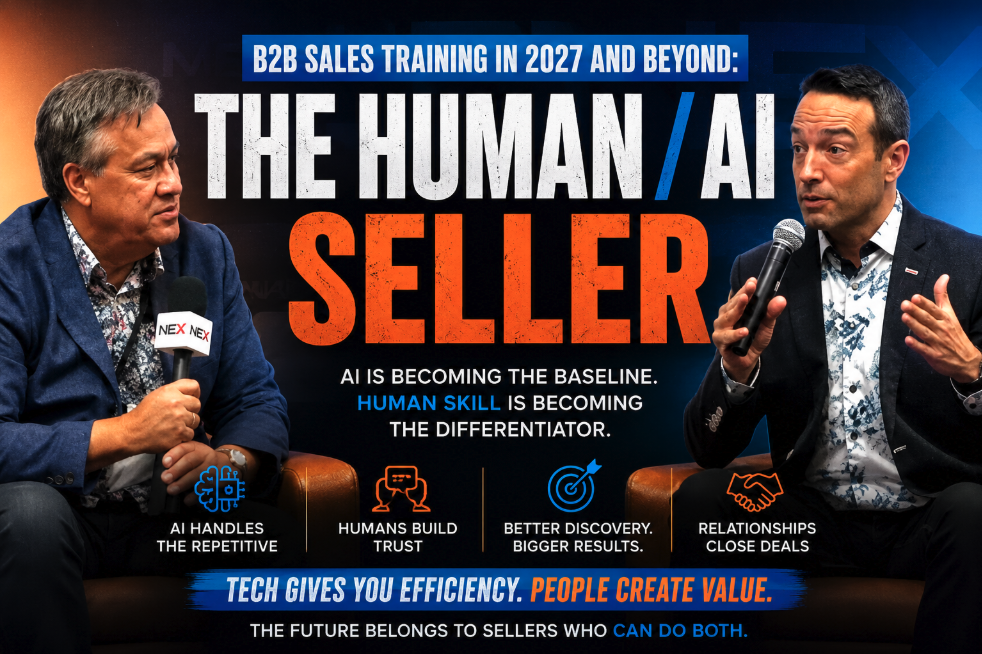
Shane Gibson on B2B Sales and the Human AI Factor
Why is AI becoming the ticket to the sales conference, not the reason you win?
The easiest way to understand AI in sales is to think of it like a smartphone in the early days. At first it looked like a serious edge. Then it became normal. Now nobody is impressed that you have one. They just assume you do. AI is heading the same direction.
It is moving into CRMs, prospecting platforms, note-taking tools, pipeline reviews, account planning, proposal drafting, and meeting preparation. It will summarize calls, surface patterns, suggest next steps, help personalize messaging, and remove a lot of routine work that used to eat up a rep’s day. That is all useful. In fact, it should be welcomed if it gives salespeople more time for the work that really matters.
But once everyone has access to similar levels of automation and augmentation, the edge shifts. If everybody has an Ironman suit on, it comes down to the pilot.
That is where the real game is played. Technology can give you speed, reach, and efficiency. It cannot replace commercial judgment. It cannot create trust in a buying conversation. It cannot sit in front of a stakeholder group, notice hesitation from finance, caution from operations, enthusiasm from one power player, and political resistance from another, then guide the conversation in a way that keeps the deal alive. That still takes a capable human being with awareness, credibility, and the ability to lead.
What does the Human / AI seller actually look like?
The Human / AI seller is not just a traditional rep using a few new tools. They are also not a tech-driven operator hiding behind prompts and automations. They are a blended professional who knows how to let systems handle the work that should be systemized, while they focus their best energy on the parts of selling that still require a human touch.
That usually means they use AI for things like:
- research
- summarizing information
- drafting and refining early messaging
- organizing account intelligence
- cleaning up workflows
- spotting patterns and opportunities in data
Then they bring their own human strengths to the parts that actually move business forward:
- discovery
- listening
- judgment
- communication
- stakeholder management
- negotiation
- trust-building
- creative problem solving
- leadership in the conversation
This matters because B2B selling is not getting simpler. In most industries it is getting more crowded, more digital, more political, and more complex all at once. The Human / AI seller can handle that because they use tools without becoming tool-driven. They use automation without becoming robotic. Most importantly, they use technology to create more room for better conversations.
Why will trust matter even more in 2027 and beyond?
Because selling is still about creating an environment where an act of faith can take place. That has not changed, and I do not think it is going to change anytime soon.
A buyer may look like they are purchasing software, training, equipment, advisory services, or some kind of outsourced support. On a deeper level, they are buying confidence. They are buying reduced risk. They are buying the belief that you and your organization can actually deliver what you promised, and that doing business with you will make their world better rather than harder.
That is why trust is commercial, not sentimental. Trust affects sales cycle length, stakeholder support, pricing pressure, post-sale expansion, and client retention. In long-term B2B relationships, trust is not a bonus feature. It is the infrastructure the relationship sits on.
AI can help a seller prepare. It can help them organize their thoughts. It can help them tighten their language. But it cannot replace credibility. If your outreach sounds polished but generic, trust drops. If your team automates touchpoints that should remain human, trust drops. If the buyer feels like they are dealing with a system instead of a person who understands their business, trust drops.
The organizations that win will use AI to support trust, not imitate it.
Why are people skills becoming more valuable, not less?
Because as the repeatable, left-brain parts of selling get automated, the more human parts of the profession become more valuable. This is the shift many sales teams still need to wrap their head around.
For years, a lot of salespeople survived by being good at routine activity. They could move information around, stay busy, push a process forward, and keep the machine going. Some of that work is already being replaced, and some of it frankly should be replaced. That is not bad news if you are willing to evolve.
The safe place in sales is moving toward the deeply human side of the profession. That includes:
- communication skills
- discovery skills
- listening ability
- emotional intelligence
- leadership presence
- political awareness
- the ability to create confidence in the buyer
- the ability to simplify complexity without dumbing it down
Those are not soft skills in the weak sense of the phrase. They are commercial skills. A rep who can run discovery well, challenge assumptions respectfully, uncover the real issue, and guide a buyer through complexity becomes more valuable in an AI-driven market, not less. On the other hand, a rep who only knows how to pitch, present, and send templated follow-up messages is going to feel increasing pressure.
Why will discovery become one of the biggest competitive advantages in B2B sales?
Because prescription without diagnosis is malpractice. That idea matters even more now than it did a few years ago.
AI can help you arrive at a meeting with more information. It can tell you about the company, the market, recent updates, likely stakeholders, and a range of possible business issues. That is useful. But information is not diagnosis. Diagnosis happens in the conversation, and that is where many deals are still won or lost.
The salesperson has to know how to ask the kind of questions that uncover what is really going on. Not just the stated want, but the deeper drivers underneath it. The best salespeople know how to uncover things like:
- what is creating urgency
- what happens if the client does nothing
- who is driving or blocking the decision
- what risks are sitting below the surface
- what internal politics are slowing things down
- what success actually looks like six or twelve months from now
That takes structure, but it also takes flow. A good discovery conversation is not an interrogation. It is a guided business conversation where the salesperson helps the client think more clearly about their situation. Too many reps still talk their way out of deals by explaining too early, solving the wrong problem, or rushing to present before they really understand what is at stake. The Human / AI seller uses technology to do the homework faster, then uses the live conversation to go deeper than technology can.
Why won’t generic AI content help most salespeople win?
Because average content produced faster is still average. We are moving into a phase where almost everyone can generate decent-looking content. LinkedIn posts, emails, follow-up notes, sales scripts, even thought leadership headlines are all becoming easier to produce. The problem is that polish is not the same thing as substance.
The market is going to be flooded with content that sounds fine and says very little. That creates a very real opportunity for sales professionals who have something meaningful to say and the experience to back it up.
Strong social selling was never about shouting louder. It was about using content and conversations to create trust, build relevance, and warm up meaningful one-to-one interactions. That is even more important now, because as AI-generated noise increases, authentic thinking and practical insight become easier to spot.
The best sellers will use AI to help shape ideas, tighten language, and improve consistency. But the core thinking still has to come from somewhere real. It has to come from experience, market observation, client conversations, wins, losses, pattern recognition, and actual time spent in the field. The best AI-assisted content still starts with a human spark and ends with a human fingerprint. Without that, you are not creating value. You are just accelerating sameness.
What should sales leaders be doing right now?
They should be upgrading standards, not just software. A lot of sales leaders are under pressure to do something with AI, and that pressure is understandable. But adding tools without clarity usually creates more noise than progress.
The better move is to decide what great selling should look like in an AI-supported environment. That means asking practical questions like:
- What parts of our workflow should be automated?
- What parts of the buyer journey still need strong human intervention?
- What parts of outreach can be AI-assisted but must always be human-reviewed?
- What does a strong discovery call sound like now?
- How should our team use AI for account planning without becoming lazy thinkers?
- How do we protect voice, credibility, and commercial judgment while moving faster?
Those are leadership questions, not software questions. The sales leaders who do well over the next few years will not be the ones who bought the most tools. They will be the ones who built teams that can actually use those tools without lowering the quality of the human interaction.
What should modern B2B sales training include now?
It needs to include more than product training, objection handling, and pipeline management. Those still matter, but by themselves they are not enough for where the market is going.
Modern B2B Sales Training should help salespeople develop capability in the following areas:
- stronger discovery and questioning skills so they can lead high-value conversations
- better business acumen so they can speak in terms of outcomes, risk, and commercial impact
- social and digital selling capability so they can build trust before the meeting ever happens
- AI literacy so they can use modern tools without sounding synthetic
- communication and leadership presence so they can handle complexity and influence stakeholder groups
- account strategy so they can think long term and grow the right relationships
- follow-through discipline, because trust is built after the meeting as much as during it
A serious B2B Sales Training program needs to go beyond tactics and into mindset, communication, business thinking, and execution. The future seller is not just a rep who presents well. They are a guide, a translator, a strategist, and a relationship builder with strong digital capability.
Why does the future belong to sellers who can blend digital and analog strengths?
Because the market always overreacts before it rebalances. We have seen this before. When social media first exploded, some people thought personal branding would solve everything. It did not. When CRM adoption accelerated, a lot of teams thought dashboards and data entry would fix weak selling. They did not. Now with AI, some people think prompts and automations are going to replace the hard parts of the profession. They will not.
What will happen instead is a rebalancing. The strongest sellers will use modern tools to remove friction, tighten execution, and free up time. Then they will pour that saved time into the things that do not entirely scale, but create real value:
- better client conversations
- better follow-up
- better stakeholder alignment
- better account strategy
- better questions
- better relationship development
There is a slightly contrarian point worth making here. As the market gets more digital, the analog wave actually does come back, not because technology fails, but because genuine human interaction becomes rarer and therefore more valuable. A well-timed phone call done properly can stand out. A well-run discovery meeting can stand out. A thoughtful voice note can stand out. A relevant introduction can stand out. A salesperson who genuinely understands the client’s business can stand out.
That is the future. Not old-school versus new-school. Not human versus machine. It is disciplined humans using modern tools to sell in a way that feels sharp, relevant, and real.
What will separate the top sellers from the rest in 2027 and beyond?
It will not just be effort. It will be focused effort in the right places.
The top sellers will use AI to strip away work that should not consume their best energy. They will not use it as a crutch. They will use it as a force multiplier. They will show up better prepared, ask better questions, create more confidence, communicate with more clarity, follow through better, build stronger digital credibility, and think longer term.
When the moment comes where a buyer has to make a real decision, those sellers will be the kind of professionals a client can trust. That is the Human / AI seller. That is where B2B sales is heading, and that is why organizations that want to future-proof their teams need to invest now in modern, practical, field-tested B2B Sales Training that develops both digital capability and human mastery.
Build the digital edge. Strengthen the human one. Train for both.
FAQ: AI for Sales Implementation Model
What are the five layers of an effective AI for Sales implementation model?
The five layers are leadership culture and capacity, sales process and sales methodology, a living sales playbook, AI activation, and agents and interfaces that make the capability easy to use where salespeople already work. Each layer supports the next, so weak foundations leave AI with little value worth amplifying.
Why must leadership culture and capacity come before AI activation?
Leadership establishes the purpose, expectations, coaching standards, and responsible-use practices for AI for Sales. Leaders also need enough practical technology knowledge to understand what AI can do, where it can fail, and how it should be used in real sales situations. Without capable leadership and a supportive culture, teams may misuse the technology, ignore it, or resist sharing the honest data required for improvement.
How should sales leaders use the capacity that AI saves?
Sales leaders should decide in advance where the recovered capacity will go. For a sales team, the saved time may be reinvested in account planning, discovery meetings, relationship building across buying committees, value-added follow-up, coaching, and preparation for complex negotiations. Time savings only create value when leaders protect that capacity and set clear expectations for how it will be used.
When should AI automate a sales task, and when should it augment a salesperson?
AI can automate work when the rules are clear and the relationship risk is low. AI should augment the salesperson when the work requires context, judgment, ethics, empathy, accountability, or an understanding of the customer relationship. In these situations, AI can prepare information, draft options, identify gaps, or check quality while the salesperson remains responsible for the final decision and execution.
Why should AI tools and agents be placed inside the salesperson’s existing workflow?
Salespeople already move between email, CRM systems, video meetings, messaging apps, LinkedIn, proposal tools, and mobile devices. A system that requires another platform, long prompts, repeated uploads, or extensive explanations will quickly lose adoption. Placing AI tools and agents inside the existing workflow makes the capability easier to use at the moment the salesperson needs help.
How should companies measure whether AI for Sales is improving performance?
Companies should measure both sales quality and how saved capacity is reinvested. Useful indicators include discovery quality, meeting preparation time, proposal turnaround, CRM accuracy, weak opportunities removed earlier, coaching frequency, win rate, deal quality, retention, and account expansion. Leaders should also track whether time saved by AI is being invested in the right accounts and the conversations that move client relationships forward.