
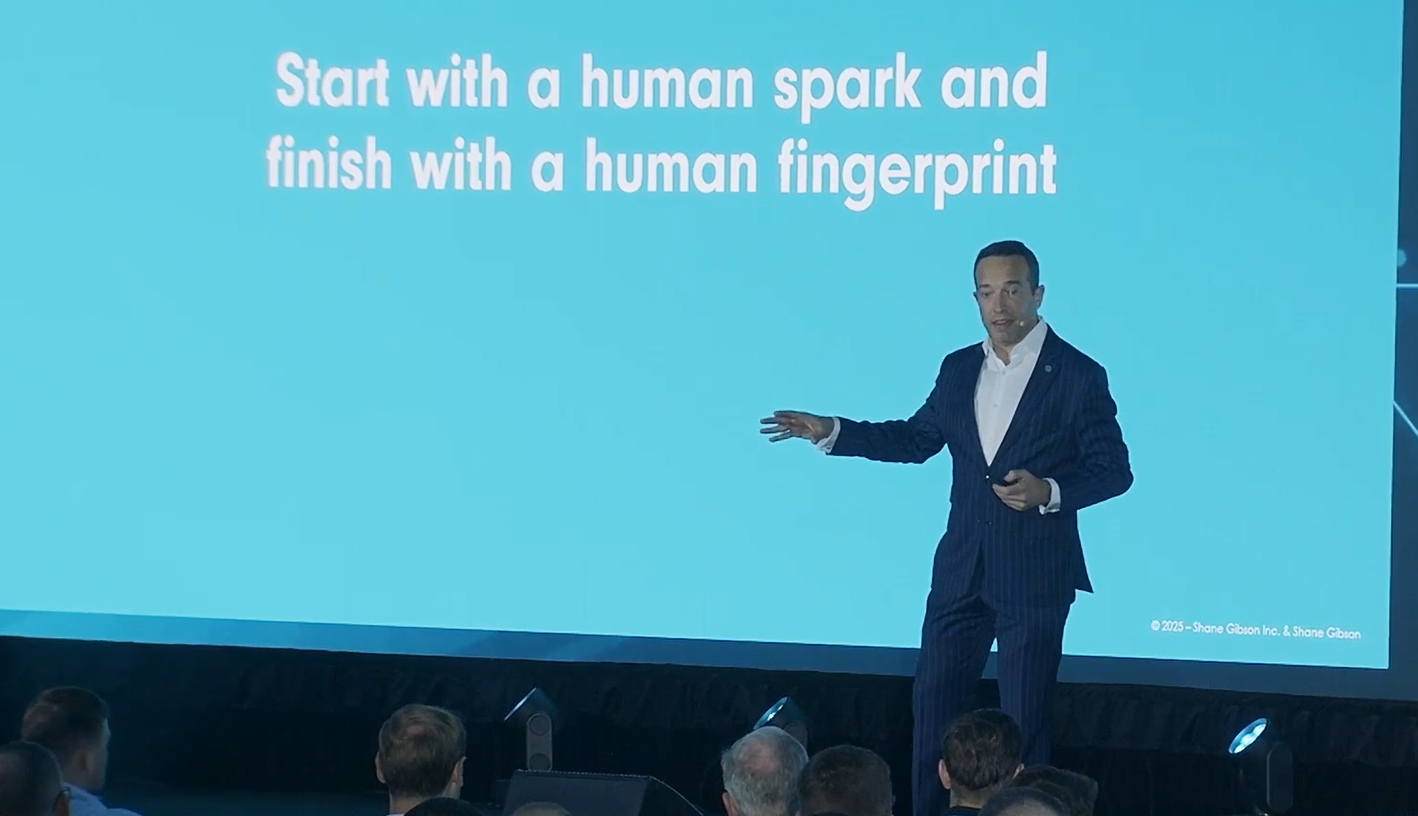
This is an excerpt from Shane Gibson’s AI Keynote address in Sydney Australia
There’s something interesting happening right now as more people start using AI for content.
On the surface, things are improving. The writing is cleaner. It’s faster to produce. In many cases, it’s technically correct and even a bit polished. But at the same time, a lot of it is starting to feel the same. You read a post and think, “That’s good,” but it doesn’t stay with you. It doesn’t feel like it came from someone with a real perspective or any depth of experience behind it.
I noticed this in my own work pretty early on. Like most people, I started by asking AI to write for me. I’d open up a tool, type in a prompt, and let it generate something. And to be fair, what came back was solid. It was structured, readable, and in many cases better than what I would have written if I rushed it.
But it didn’t sound like me.
And that was the turning point. Not because the tool wasn’t capable, but because I realized I was asking it to do the wrong job.
Most people are starting with AI when they should be starting with themselves.
Where AI Actually Starts
AI doesn’t begin with a prompt. It begins with your thinking.
It begins with the experience you’ve built over time, the frameworks you use, the way you approach conversations, and the patterns you’ve seen play out across clients and deals. That’s the real asset. That’s what gives your work weight. When that’s missing, the output feels generic, no matter how well it’s written.
I see this all the time. Someone opens up ChatGPT or Copilot and types, “Write me a LinkedIn post about AI in sales.” And what comes back is usually pretty good. It’s clean, it’s logical, and it sounds intelligent. But it’s not grounded in anything specific. It’s built from aggregated information, not lived experience.
And because of that, it ends up sounding like everyone else who asked the same question.
The Shift That Changed How I Use AI
The biggest shift for me was when I stopped asking AI to create and started asking it to refine. Now, when I have an idea, I don’t begin with a prompt. I begin by talking.
I’ll pick up my phone and just speak through the idea the way I would explain it to a client or to a room. It’s not polished. It’s not structured. It’s just how I think through it in real time, with examples, opinions, and sometimes a bit of a rant.
That becomes the starting point.
From there, I feed that into a custom AI assistant that I’ve built around my own content. It includes books I’ve written, blog posts, transcripts from talks, and the way I think about business and relationships. It’s not perfect, but it gives the system context.
So when I ask it to shape that idea into something usable, it’s not guessing. It’s working with material that already reflects how I think.
The result is something that feels a lot closer to my voice, because it started there, and even then I don’t just copy and paste it. I go back in, read it through, adjust it, and make sure it actually sounds like something I would say. That last step matters more than people think.
Because nothing should go out without a human fingerprint on it.
When AI Goes Sideways
There’s another side to this that’s worth talking about, because it’s where a lot of people run into trouble.
AI is very good at scaling things. It can take an idea and multiply it quickly. But it doesn’t judge whether that idea is actually solid to begin with.
I learned that the hard way.
I tested an outbound tool that was designed to automate prospecting. I uploaded my ideal client profile, let it generate a large list of contacts, and turned it on. It looked efficient. It felt like I had just accelerated my pipeline overnight.
Then I checked it the next morning. Unsubscribes. Complaints. Responses that made it clear the messaging missed the mark completely.
The issue wasn’t the tool. It was that I hadn’t grounded it in how I actually communicate or how I approach clients. There was no real framework behind it, no clear voice, and no refinement before I scaled it.
I turned the volume up before I had clarity.
And AI will do that very quickly.
What Actually Makes an AI Assistant Work
When I look at the AI setups that are working well, whether in my own business or with clients, they all have something in common.
They’re built on something real.
There’s usually a body of content behind them. Not just prompts, but actual thinking. Past work, conversations, frameworks, and examples that reflect how that person or team operates. There’s a clear sense of voice, and you can tell what they stand for.
They’ve taken the time to define what good looks like before asking AI to replicate it.
Without that, you’re asking the system to create something from nothing. And what you get back is exactly that. Something that sounds right, but doesn’t carry much weight.
The Principle That Keeps This Grounded
There’s one idea I keep coming back to, especially when people ask how to use AI without losing themselves in the process.
Start with a human spark and finish with a human fingerprint.
The spark is your thinking. Your perspective. Your experience in the field. That’s the part that gives the work its edge.
The fingerprint is what happens at the end. You step back in, review what’s been created, and make sure it reflects how you actually think and communicate.
AI sits in the middle.
When you use it that way, it becomes a tool that supports you instead of replacing you. It helps you move faster, but it doesn’t strip away what makes your voice distinct.
When you skip those steps, it tends to produce something that feels fine but doesn’t stand out.
What This Looks Like in Practice
If you’re looking to apply this without overcomplicating it, the shift is actually pretty simple.
It starts with capturing your thinking before you try to scale it. That might be a voice note, a rough draft, or even notes from a conversation. Give the system something real to work with.
From there, begin feeding in your past content and frameworks so it has context. Over time, that builds a stronger foundation, and the output improves.
Then it becomes a process of refinement. You test what comes out, adjust how you’re prompting, and pay attention to whether it actually sounds like you. That feedback loop is where most of the improvement happens.
It’s not about building the perfect system upfront. It’s about shaping it as you go.
Key Takeaways You Can Apply Right Away
If you want to train an AI assistant to actually write well and sound like you, here are a few practical ways to get started.
- Start by capturing your ideas in your own words before using AI
Speak them out or write them roughly. Give the system something real instead of asking it to create from nothing. - Build your assistant around your existing content
Use past posts, emails, presentations, and transcripts to give it a sense of how you think and communicate. - Be clear on your voice and point of view
Know what you believe, how you approach problems, and what you want your content to reflect. - Test and refine before scaling anything
Start small, review the output, and improve it before pushing it out at volume. - Always review and edit before publishing
Make sure what goes out actually sounds like you. That final pass is where your voice is protected.
The technology is going to keep improving. That part is inevitable.
The real advantage will come from how clearly you think and how intentional you are about bringing that thinking into the tools you use.
Use AI to extend your voice, not replace it.