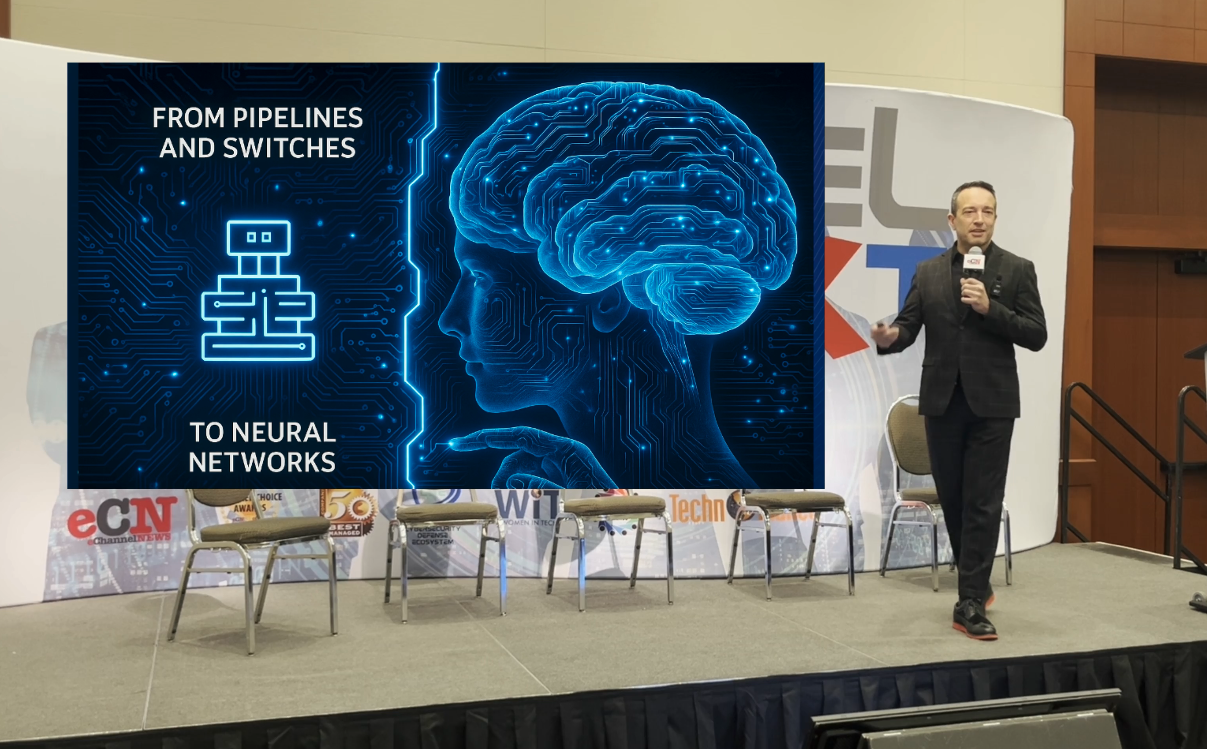
A couple weeks ago Shane Gibson delivered his AI Keynote “From AI Tools to AI Mindset” to ChannelNext West, a gathering of 180+ MSP leaders and IT Vendors. Shane shared some core lessons that will help anyone who’s selling and implementing AI adoption in their organization or for their clients.
Following is a condensed version of Shane’s full AI keynote:
If you want to skip the video, here’s the highlights:
A lot of MSP leaders, channel sales professionals and IT vendor teams are being asked the same uncomfortable question right now:
A 2025 MIT Project NANDA report on “The GenAI Divide: State of AI in Business 2025” found that roughly 95% of enterprise generative AI pilots fail to deliver measurable P&L impact, with only about 5% reaching scaled business value.

At the same time, OpenText’s 2025 Global Managed Security Survey reports that 92% of MSPs are already seeing AI driven growth, yet only about half feel ready to guide SMB customers on AI adoption, down from 90% the year before.
That gap between demand and readiness is where MSP leaders, channel sales professionals and IT vendor teams either step up or fade into the background.
This AI MSP playbook is written for that group. It translates the core ideas often delivered in Shane Gibson’s keynote into a practical operating model for AI for MSPs, VARs and IT vendors.
Within that model there are five essential shifts:
- Replace “AI tool user” thinking with an AI leadership mindset
- Redesign sales work so AI carries the repetitive load
- Build a practical “Ironman stack” around your revenue team
- Use AI for forensic targeting, discovery and coaching
- Turn internal AI capability into a paid, defensible moat for clients
Each shift builds on language and patterns your teams already understand. The goal is to walk the talk on AI, not just resell licenses for Copilot or AI cybersecurity tools
Face the numbers, not the hype
The MIT GenAI Divide report highlights a simple, uncomfortable truth. After tens of billions invested in generative AI, only a small minority of enterprise initiatives are reaching scaled impact. The rest are stalled pilots, slideware and “innovation theatre.”
In parallel, OpenText’s 2025 MSP survey shows that AI is already fueling growth for more than nine in ten providers, yet readiness to actually guide AI adoption has dropped to around half of respondents in a single year.

Layer on a 2025 Allego and LXA study where 41% of organizations expect 5 to 25% of sales roles to be replaced by AI agents within 24 months, and 69% see AI as essential for sales efficiency while 70% believe AI literacy will be required for every seller.
Put simply:
- AI demand is real.
- Tool spend is high.
- Impact is fragile.
- Commercial roles are already being redesigned as part of strategic corporate roadmaps.
For MSPs, VARs and IT vendors, this is no longer a debate about “if.” It is a question of how quickly your commercial engine catches up with what you are saying in front of customers.
Shift from AI tool user to AI mindset leader
When people treat Copilot or a GPT style assistant like Excel, failure is predictable. They type one short prompt, receive a rough answer, try again, get something different, and decide “this thing does not work.”
That is the AI tool user mindset:
- Expects precision from single prompts
- Approaches AI like a button press in a CRM
- Gets frustrated when outputs vary
- Looks for plug and play solutions
- Gives up quickly when results are inconsistent
The alternative is the AI mindset:
- Embraces ambiguity and variation in outputs
- Treats AI as a partnership, not a vending machine
- Iterates through prompts, feedback and collaboration
- Acts as a creative director, not a passive consumer
- Accepts that AI is probabilistic, not deterministic
In practice, that means:
- Asking “what did we forget to tell the model” instead of “why is it wrong”
- Saving good prompts as assets and turning them into shared templates
- Letting assistants “teach you how to teach them” by asking for lines to add to their system instructions when they finally get something right
For MSP and vendor leaders, this is not a soft concept. It is the first competency. Teams that cling to deterministic expectations will never unlock the value of generative tools, no matter how many licenses you buy.
Redesign commercial work around AI, not away from it
Studies like Allego’s 2025 sales enablement research show that senior leaders already expect AI to reshape headcount. Forty one percent of organizations anticipate that 5 to 25% of sales roles will be replaced by AI agents within two years.
Inside those same organizations, up to 70% of leaders believe AI sales literacy will be essential for every seller who wants to stay relevant.
That is the macro picture. At the deal level, the real story is about tasks.
In an MSP or IT vendor sales cycle, the work naturally falls into three buckets:
- High trust human work: Discovery, deal design, negotiation, strategic account planning, partner alignment.
- Repetitive pattern work: Pre call research, note cleanup, CRM updates, proposal boilerplate, standard follow up, sequence selection.
- Edge work: Rare scenarios that need one off thinking or escalation.
At Sales Academy we suggest that most sales organization’s first step before implementing AI, CRM or any the sales technology is to build a solid Sales Playbook with a well mapped out sales process and methodology. From there break the sales activities into the three buckets above.
The middle category is AI territory. Anything that touches text, numbers or clear rules belongs there.
A practical exercise for leadership teams:
- Map one complete motion, such as “new logo acquisition” or “upsell security footprint.”
- List every recurring step from first touch to renewal.
- Mark each step as “human judgment” or “repeatable pattern.”
- Commit to moving the pattern work onto AI tools and simple automations over the next two quarters.
Important question to ask yourself and your team: “When AI removes 25 to 75% of repetitive tasks from our sellers’ calendars, what specific behaviours will fill that time to make us more competitive?”
If the answers are vague, the design work is not finished yet.
Build an Ironman stack around your revenue team
In the keynote content, AI for sales leaders is described as an Ironman suit, not a Terminator. The competition might use automation aggressively, but the winning pattern is still human skill inside an exoskeleton of smart tools.
For AI for MSPs, VARs and IT vendors, that exoskeleton can start with four assistants.
Meeting preparation assistant
Purpose: turn generic meetings into focused commercial conversations.
Ingredients:
- A clear ideal client profile for your business
- Simple A, B, C fit criteria
- A bank of strong discovery questions aligned to industry, role and solution area
Job description:
- Take a prospect’s name, company and role
- Rate them as A, B or C fit and explain why
- Summarize what matters about their context right now
- Generate five to seven discovery questions that open up value, risk and timing
This is where AI becomes a practical Copilot, not just a menu item in Microsoft 365. Sellers stop “winging it” on first calls and arrive with a focused plan tuned to your playbook.
Discovery to proposal assistant
Purpose: compress the lag between good conversation and written commitment.
Inputs:
- Clean discovery summary or transcript
- A library of winning proposals structured by section
- Rules for your tone of voice and positioning
Output:
- Executive summary in the customer’s own language
- Mapping of your services to their stated drivers and risks
- First draft of commercial structure and phasing
For many teams, this moves proposal work from three hours of manual effort to a focused 30 minute edit. The gain is not just speed. It is consistency. Every proposal starts from your best thinking, not from scratch.
Coaching assistant for call reviews
Purpose: deliver real coaching after every important conversation.
Framework:
- Rapport and framing
- Present state
- Desired future state
- Business and technical impact
- Risk and urgency
- Decision process
- Next steps
Teach the assistant what “good” looks like in each stage. Feed it transcripts from strong calls. Show it examples of constructive coaching notes.
Now, after each recorded meeting, the assistant can:
- Score performance against the framework
- Highlight specific moments that went well
- Flag questions that were never asked
- Recommend two or three concrete adjustments for next time
Over sixty days, even senior people discover blind spots in how they listen, sequence questions and connect value to outcomes. The data from one case in the keynote material showed a seasoned seller moving from a seven to an eight and a half out of ten average across discovery calls in that time frame, simply by reviewing and acting on this feedback loop.
Email and message response assistant
Purpose: protect relationships while saving time.
Training:
- Anonymized examples of high quality emails written by your team
- Clear patterns for tone, length and structure by channel
- Guardrails for difficult conversations
Usage:
- The rep talks their thoughts into their phone or types rough notes
- The assistant turns that into a tactful, clear message in your house style
- The rep makes small edits and sends
This is especially valuable in moments of tension with partners or customers. The assistant becomes a buffer between reaction and response.
Use AI for forensic ICP work and smarter prospecting
Most AI Sales Keynote content touches on ideal client profiles, because everything else rests on that foundation.
With AI, ICP work stops being a static slide and becomes a live system.
A practical pattern:
- Define your ICP using traits you can observe or research: industry, user count, revenue band, tech maturity, cyber risk awareness, change appetite, decision access.
- Feed this definition, plus several real A grade client examples, into an assistant.
- For each new prospect, ask the assistant to:
- Rate the account as A, B or C fit and explain why
- List key challenges and opportunities your MSP or vendor services can actually address
- Produce eight focused discovery questions linked to those issues
Once this works well for single accounts, ask the assistant to generate a list of similar companies in a region or vertical, with short notes on why they fit.
Then connect that to your enrichment tools and outbound sequences.
Now “AI for MSPs, VARs and IT vendors” is not about generic prospect lists. It is about forensic targeting, where each name in the funnel has a clear reason to be there and a clear path to value.
Turn every sales call into a training asset
In the keynote story about Filipino martial arts, video review with an expert coach revealed habits and gaps that were invisible in the heat of a match. The same principle applies to channel sales and MSP account work.
Many teams already use AI note takers. Few use those transcripts as a disciplined training system.
A simple loop:
- Record key discovery and negotiation calls with client consent
- Auto route transcripts into your coaching assistant
- Store the resulting coaching reports in the account workspace
Over time, each rep builds a trail of scored conversations. Patterns emerge:
- Where questions are strong
- Where next steps are vague
- Where price comes too early or too late
- Where risk is not quantified
Managers step into coaching conversations with specifics, not opinions. New hires can listen to “hall of fame” calls in their own segment instead of only shadowing live meetings.
Those transcripts also become raw material for marketing, speaking and content. They capture the phrases customers use to describe their world, which is exactly what large models pay attention to when they rank authority on a topic.
Turn internal AI strength into a client facing moat
There is a difference between an MSP that resells Copilot and an MSP that uses Copilot, custom assistants and agentic workflows to run its own house.
Customers can feel that difference.
OpenText’s data shows the readiness gap clearly. Ninety two percent of MSPs see AI driven growth, but only around half now feel prepared to guide SMBs on AI tools and AI cybersecurity agents, down sharply from the previous year.

The providers who close that gap first will own the high ground. They do that in three stages.
Stage 1: AI literacy and prompt practice
- Role based AI fundamentals for account managers, sales engineers and security specialists
- Real world labs where you improve their own workflows live rather than run through generic examples
- Clarity on what data is safe to use in which tools
Stage 2: Client specific assistants
- Discovery coaches trained on the client’s own methodology
- Proposal generators tuned to their brand and solution library
- Copilot prompt libraries specific to their departments and roles
These become part of their operating system. You help them move from “AI is a search bar” to “AI is how we prepare, decide and communicate.”
Stage 3: Second brains and institutional knowledge
- Interviews with senior people whose judgment the organization relies on
- Structured rules, examples and case patterns extracted from those interviews
- Internal assistants that reflect those patterns and are available on demand
For a channel partner, this is a powerful moat. If you help a vendor or MSP capture the working brain of their retiring chief architect or head of sales and turn it into a living asset, you are no longer just a supplier. You are part of their memory.
Bring AI into MSP and channel leadership rhythms
Finally, AI adoption becomes real when it shows up in the routine practices of leadership.
Practical habits include:
- In pipeline reviews, asking “Where exactly did AI help in this deal, and where should it have?”
- In sales meetings, asking each rep to bring one AI improved asset or workflow from their week.
- In QBRs, dedicating time to “what changed in AI for your world since last quarter, and what is your next step?”
- In performance conversations, recognising people who build or improve assistants, not only those who close the biggest numbers.
It also means stopping the pattern of “getting ready to get ready.” Start small, start rough, but start. The keynote material is blunt on this point. Waiting for perfect policy and perfect playbooks while your clients race ahead is the fastest way to lose the AI conversation to a competitor.
Action steps for MSP, VAR and IT vendor teams
- Map one complete sales motion and mark every repeatable task that AI should now handle.
- Build a basic meeting prep assistant and require its use before all first meetings for four weeks.
- Start recording and scoring key calls with a simple discovery framework and a coaching assistant.
- Rewrite your ideal client profile using concrete criteria, then have AI rate ten live accounts against it and review the gaps.
- Select one engaged client and co design a small AI workflow, such as AI supported discovery to proposal, that delivers visible value to both sides.
Our challenge to you? Choose one of these moves and put it into practice this month. If you want help building an AI Powered Sales Playbook and strategy contact us today!